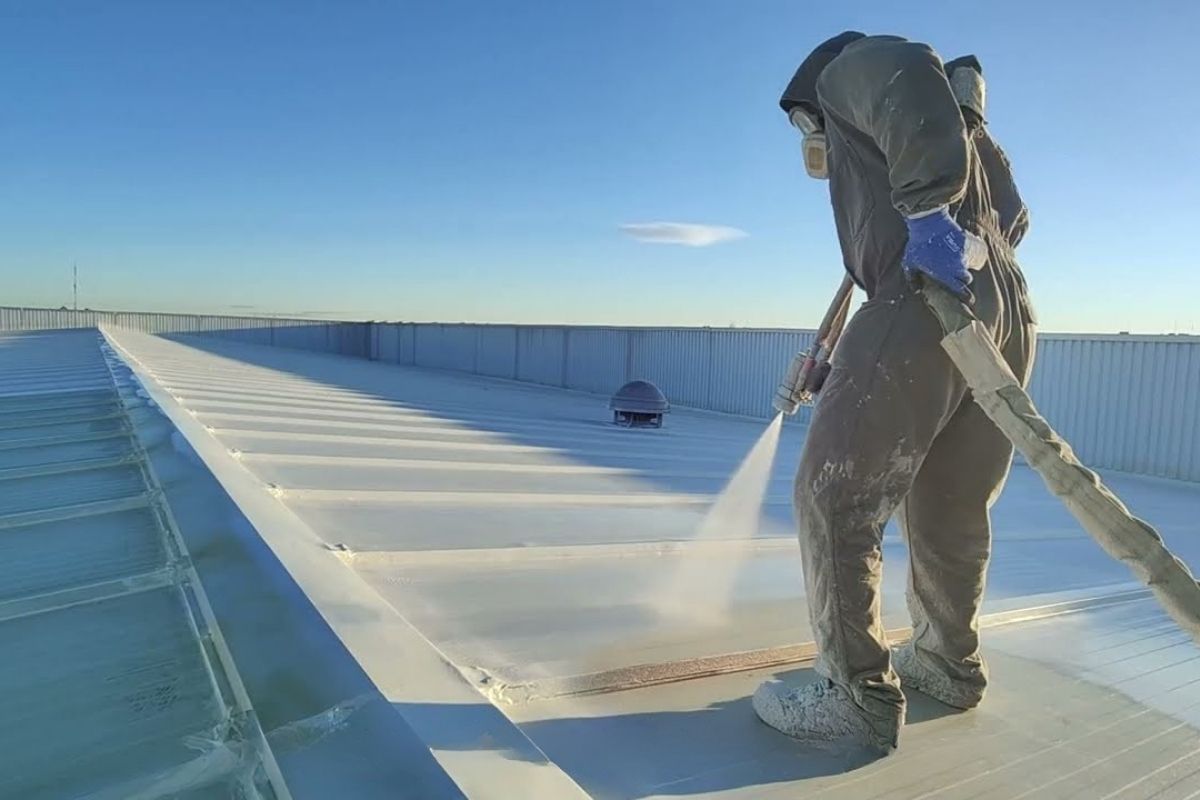
Sandwich panel roofs are widely preferred in industrial buildings due to their lightweight structure, fast installation, and cost advantages. However, panel joints, fastener heads, drainage channels, and roof penetrations can become potential leakage points over time. Particularly on large-span factory and warehouse roofs, even a minor leak can spread across extensive areas and result in significant damage.
Polyurea waterproofing for sandwich panel roofs offers a system-based solution that covers the entire roof surface rather than addressing individual problem areas one by one. Including panel joints and connection details, the entire roof is coated to provide a highly resistant barrier against water infiltration.
Why Are Sandwich Panel Roofs Vulnerable?
- Water penetration through fastener holes over time
- Opening of panel joints and seal deterioration
- Expansion and contraction caused by UV exposure and temperature fluctuations
- Micro-movements generated by wind loads
- Water accumulation around gutters and parapet details
These issues are often addressed with localized repairs. However, every repair has the potential to create a new weak point. For this reason, a comprehensive coating system provides a more sustainable solution.
Advantages of the Polyurea System
Polyurea is a fast-curing, highly elastic coating system that can be applied directly onto sandwich panel surfaces.
Application Process
Technical Properties of the Polyurea System
| Technical Parameter | Typical Range | Description |
| Tensile Strength | 18 – 25 MPa | High mechanical strength and resistance to tearing |
| Elongation at Break | 400% – 1000% | Accommodates substrate movement |
| Tear Resistance | 70 – 100 kN/m | Resistance to mechanical stresses |
| Shore A Hardness | 85 – 95 | Combines elasticity and durability |
| Water Vapor Permeability | < 1 g/m²·day | Excellent waterproofing performance |
| Curing Time | 5 – 15 seconds gel time | Rapid reaction and short installation time |
| Service Temperature | -30°C / +120°C | Wide operating temperature range |
| Application Thickness | 2 – 3 mm (roofing systems) | May vary depending on project requirements |
Elongation values approaching 1000% may be achieved with certain specialized formulations. However, for industrial roofing and flooring applications, a realistic and sustainable range is typically between 400% and 800%. Higher values do not always mean better performance; mechanical balance remains critical.
Suitable Applications
- Factory roofs
- Manufacturing facilities
- Logistics warehouses
- Aircraft hangars
- Industrial complexes
In active production facilities, roof leaks affect not only building components but also machinery, raw materials, and manufacturing processes.
Warranty Period and Coverage
Our Polyurea systems are provided with a written 5-year warranty when proper surface preparation and specified coating thicknesses are achieved. This warranty covers not only the material but also the integrity of the application system.
- Waterproofing performance
- System integrity based on specified coating thickness
- Adhesion performance
- Water-tightness at critical details such as joints, connections, and penetrations
How Does the Warranty Process Work?
- A surface assessment is conducted before application.
- A technical inspection report is prepared as part of the consulting process.
- Coating thickness and surface integrity are verified after application.
- A warranty certificate is issued.
In industrial facilities, the primary risk is not water itself—it is the cost of operational downtime. For this reason, waterproofing should be planned not as a temporary repair, but as part of a long-term building protection strategy.
Consider waterproofing not as an expense, but as an investment in long-term operational security.
 Contact us directly by phone0212 284 4045
 Get a quick preliminary assessment via WhatsApp
 Request consultation and a technical site survey