Roof insulation is one of the most critical insulation applications used in buildings to prevent heat loss, save energy, and prevent water leaks.
If you’re experiencing problems such as mold, dampness, or high energy bills on your roof, you likely need a quality roof insulation application. Poorly insulated roofs threaten the structural stability and comfort of a building. Proper insulation provides protection against seasonal conditions and extends the life of the building.
Roof insulation is a thermal, sound, and water insulation system applied above or below the roof surface. This application:
- Provides a cool interior in summer and a warm interior in winter.
- Reduces the impact of external noise.
- Prevents rain and snow from damaging the building.
Roof Insulation Application Types
Cold Roof Insulation
Cold roof insulation is an insulation system that creates ventilation in the space between the roof and the interior ceiling. This system is particularly preferred for buildings with sloped roofs and those without attic living space. The insulation material is applied directly above the interior ceiling, not on the roof deck. This allows the attic to remain close to the outdoor temperature while insulating the lower floors.
How Does Cold Roof Insulation Work?
In this system, the outer shell of the roof is not insulated. Instead, the layer between the living space and the roof is insulated. Air circulation within the roof is freed, providing the following advantages:
- Condensation and moisture formation are prevented.
- The lifespan of the wooden or steel elements in the roof structure is extended.
- The risk of overheating in the summer and icing in the winter is reduced.
Cold Roof Insulation Application Stages
1. Structural Analysis
- The existing roof system is examined.
- The suitability of the load-bearing system is checked.
2. Selection of Insulation Material
- Generally, glass wool, rock wool or EPS boards are preferred.
- It is important that the material is fire and moisture resistant.
3. Application
- Thermal insulation material is placed in the upper part of the ceiling.
- Vapor barrier and ventilation gaps are carefully planned.
- Moisture barriers and fire retardants are added if necessary.
Advantages of Cold Roof Insulation
- It is economical; there is no need to insulate the entire area since the attic is not used.
- It is applied quickly and requires less material and labor.
- It breathes; thanks to ventilation, mold and fungus do not form.
- It reduces the risk of corrosion; rust that may occur due to condensation on metal roofs is prevented.
Warm Roof Insulation
Warm roof insulation is an insulation system installed just below the roof sheathing, completely enveloping the roof structure in an insulating layer. In this system, the entire structure, including the attic, is considered a warm zone. This protects both the interior and the roof structure from external factors.
It is an ideal insulation method, particularly preferred for flat roofs, terraced roofs, and attics used as living spaces.
How Does Warm Roof Insulation Work?
A warm roof system combines water and thermal insulation. The insulation wraps the entire roof surface, creating a seamless barrier between the interior and exterior.
This system:
- Minimizes heat loss,
- Protects roof elements from temperature fluctuations,
- Prevents mold growth by preventing condensation.
How to Apply Warm Roof Insulation?
1. Surface Preparation
- The current condition of the roof is analyzed.
- Cleaning and repairs are carried out.
- The slope direction is determined, and the drainage system is checked.
2. Vapor barrier layer
- A vapor barrier layer is placed to prevent vapor from damaging the insulation layer.
- In particular, the passage of steam from the interior environment is prevented.
3. Thermal Insulation Layer
- XPS, EPS, rock wool, polyurethane boards or spray insulation products are preferred.
- The boards fit tightly together and thermal bridges are prevented.
4. Waterproofing Layer
- Waterproofing is achieved with bituminous membrane, PVC membrane or liquid insulation materials.
- Special insulation tapes are used in detail areas.
Inverted Roof Insulation
Inverted roof insulation is a special insulation system that involves placing thermal insulation material on top of the waterproofing layer, rather than underneath it. This structure ensures long-lasting thermal and waterproofing. Unlike traditional (warm) roofs, the thermal insulation material is placed above the waterproofing layer.
Inverted roofs are generally ideal solutions for terrace roof systems, roof areas open to heavy pedestrian traffic, green roofs, or roofs with solar panels.
How Does Inverted Roof Insulation Work?
In this system, waterproofing is first implemented. Then, special XPS (extruded polystyrene) boards are placed on top of the waterproof layer. This insulation material:
- It is not exposed to direct sunlight.
- It is protected against physical impacts.
- The waterproofing layer remains long-lasting, unaffected by UV and temperature fluctuations.
What are the materials used?
Polyurethane Spray
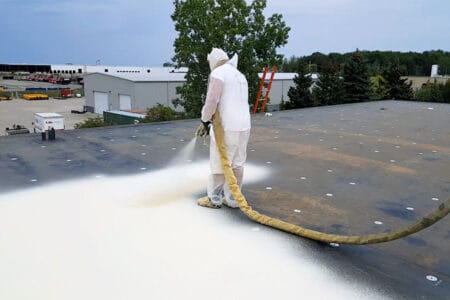
Polyurethane spray is a modern, high-performance insulation material used in roof insulation. Its two-component structure (polyol and isocyanate) reacts during application to form a hard, uniform, and void-free layer on the surface. This feature provides both thermal and waterproofing properties simultaneously.
One of the most significant advantages of polyurethane spray is its excellent adhesion to the applied surface, leaving no gaps or joints. It provides much more leak-proof and homogeneous protection than traditional sheet systems. It can also be easily applied to sloped, flat, complex, or hard-to-reach surfaces.
Its high thermal conductivity minimizes energy losses. Its lightweight structure also provides maximum insulation without placing additional stress on the roof’s structural system. Its waterproof nature makes it a popular choice, particularly in warm and inverted roof systems. It has a short application time and a rapid drying time. It is also available in fire-resistant and environmentally friendly formulations.
Polyurethane spray is one of the most effective solutions for roof insulation in terms of both performance and longevity. It is an ideal material for those looking for a system that is highly energy efficient, maintenance-free and resistant to harsh weather conditions.
Bituminous Membranes
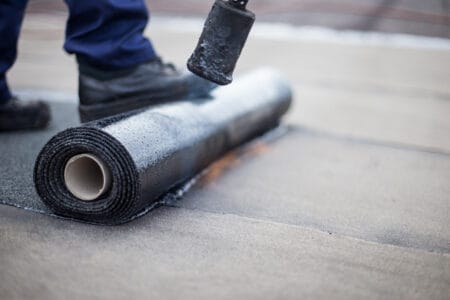
Bituminous membranes are proven waterproofing materials used for many years in roof insulation. These membranes, whose primary component is bitumen (a derivative of asphalt), are typically reinforced with polyester felt or fiberglass backing. Their flexible, durable, and waterproof nature makes them widely used on both flat and sloped roofs.
These materials are rolled and applied to the surface by melting them with a torch. The underside becomes tacky when heated, adhering firmly to various roof substrates such as concrete, wood, or metal. They are generally applied in two layers: the first layer serves as a primer, while the second layer completes the waterproofing. Types with mineral coatings on the upper surfaces provide additional UV resistance.
The greatest advantage of bituminous membranes is their complete waterproofing and maintenance-free performance for years. Furthermore, their high tensile strength and resistance to heat and cold fluctuations ensure their performance is unaffected by climate change.
They are particularly preferred for warm roof insulation, inverted roof systems, terrace roofs, parking garages, and areas exposed to rain. It offers special solutions for each project with different thickness, reinforcement and coating options.
XPS / EPS Boards
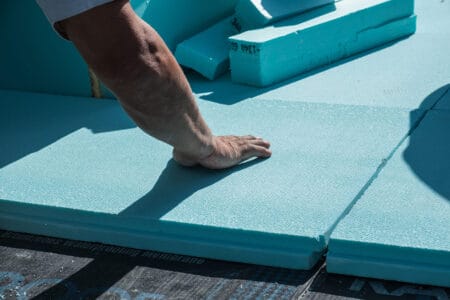
XPS (Extruded Polystyrene) and EPS (Expanded Polystyrene) boards are commonly used thermal insulation materials for roof insulation. Lightweight, durable, and easy to apply, these boards are preferred for both energy savings and increased indoor comfort.
XPS boards have a homogeneous, closed-pore structure. This structure provides low water absorption and high vapor permeability. They are particularly ideal for applications likely to be exposed to water, such as inverted roof insulation. Their high compressive strength allows them to easily support roof loads and allow for the application of coverings such as gravel, tiles, and green spaces.
EPS boards, on the other hand, have an open-pore structure and are a more economical thermal insulation solution. Their lightweight structure makes them easy to install. They are typically used on sloped roofs and in attic ceilings. However, their water absorption rate is higher than XPS, so they should be applied with a good vapor barrier layer.
Both materials can be produced in various thicknesses and have low thermal conductivity coefficients, allowing for maximum insulation performance with minimal thickness. There are also fire-resistant types and environmentally friendly versions available.
How to Insulate a Roof?
Preparation Process
- The surface is cleaned.
- Damaged areas are repaired.
- The slope is checked.
The success and longevity of roof insulation is directly dependent on the preparation process performed before application. This stage involves analyzing the roof’s current condition and preparing it for application. First, the roof’s structural condition is thoroughly examined; any existing waterproofing is tested, and any damaged or weak areas are identified. Any cracks, slope irregularities, or depressions on concrete surfaces are repaired. On wooden roofs, any rotten, damp, or weakened structural elements are replaced.
During surface preparation, all dust, dirt, oil, and loose particles are removed. Applications performed without a clean, dry, and smooth surface will significantly reduce the insulation’s performance. Therefore, high-pressure water or mechanical cleaning methods are used if necessary.
The roof’s slope is also checked during the preparation stage. A minimum 2% slope is required to drain rainwater and snow water before they accumulate on the surface. If the slope is insufficient, slope concrete is applied. The locations of drain points, slope breaks, and parapet wall details are also determined during this stage.
Finally, a suitable primer is applied to the surface, depending on the insulation system to be applied. This primer ensures better adhesion of the insulation material to the surface and improves application performance. When all these preparations are carried out correctly, the roof insulation application is much more efficient, durable, and long-lasting.
Insulation Layer Application
- Depending on the material type, spraying, laying or gluing is done.
- Attention is paid to waiting times between coats.
Once the preparation process is complete, the most critical phase of roof insulation begins: the application of the insulation layer. At this stage, materials providing thermal, water, or sound insulation are applied to the roof surface, depending on the chosen insulation system. The materials and application techniques are determined by considering the type of roof (flat, sloped, terrace), its intended use, and climatic conditions.
Insulation boards (e.g., XPS, EPS, or rockwool) are laid or glued to the smooth surface. They are placed without any gaps between the boards; this prevents the formation of thermal bridges. If spray systems such as spray polyurethane are used, a uniform thickness is applied to the surface, resulting in a solid, gap-free insulation layer. This method leaves no joints, ensuring high efficiency in terms of water and air tightness.
Bituminous membranes, PVC/TPO membranes, or liquid waterproofing products can be used for the waterproofing layer. Bituminous membranes are heated with a torch and adhered to the surface, and the joints are welded together. Liquid products are applied with a roller, brush, or spray, forming an elastic and waterproof layer as they dry.
Throughout the entire installation, detailed areas (chimney bases, parapet edges, and drains) are insulated with special care. Special insulation tapes, corner profiles, or reinforcement layers are used in these areas. During application, the curing times between coats must be observed in accordance with the manufacturer’s recommendations. New coats should not be applied until the coats are completely dry.
In conclusion, the application of the insulation layer is a vital step that directly affects the roof’s energy efficiency, waterproofing, and structural life. Application with the right materials, technical knowledge, and experience ensures comfortable and safe living spaces in the long term.
Final Checks
- Leakage tests are performed.
- Detailed areas are protected with special coatings.
After the insulation application is completed, final checks must be performed to ensure the roof is long-lasting and leak-proof. This step is crucial for verifying the quality of the work and identifying potential application errors before they become problematic.
First, the insulation layers are inspected visually and physically. Material thickness, joints, and detail solutions (chimney bases, parapet edges, and drain surrounds) are carefully examined. If coating products such as bituminous membranes are used, the joints are tested for proper welds. For spray or liquid applications, the surface is inspected for any gaps, cracks, or loss of integrity.
Following this, a water leak test is recommended. This is typically performed by applying water in a controlled manner or using leak testers. The proper functioning of the drainage system, without creating puddles, should also be verified at this stage. Confirming that the drains are unblocked and that the slope is correct is critical to the success of the application.
Furthermore, documentation must be provided that the products used were applied in accordance with their technical data sheets and the manufacturer’s instructions. If necessary, detailed analysis can be performed using technological equipment such as a thermal camera or moisture meter.
Following all these checks, the project file is prepared and final approval is given before the insulation application is covered by the warranty. Thorough and professional final inspections are crucial for the durability and performance of the roof insulation.
Our Roof Insulation Service
Our company offers you the best service in roof insulation applications with its expert staff and guaranteed solutions:
- On-site survey
- Material and application consulting
- 10-year warranty
- Energy efficiency consulting
Roof insulation isn’t just essential for comfort; it’s also essential for long-term energy savings and building safety. Our professional team is always here to help you with reliable and affordable solutions.