“`html
If you operate an industrial facility, the performance of your roof is just as critical as your production schedule. An unseen weak point can quickly turn into an unexpected failure. And as downtime increases, costs escalate. For this reason, a roofing system should be viewed as an operational risk management investment.
Even the smallest water leak in a production facility can:
- Create risks for electrical systems
- Affect machinery and equipment
- Disrupt production lines
- Generate costs due to operational downtime
For this reason, the selection of an industrial roofing system should be based on risk management rather than price alone.
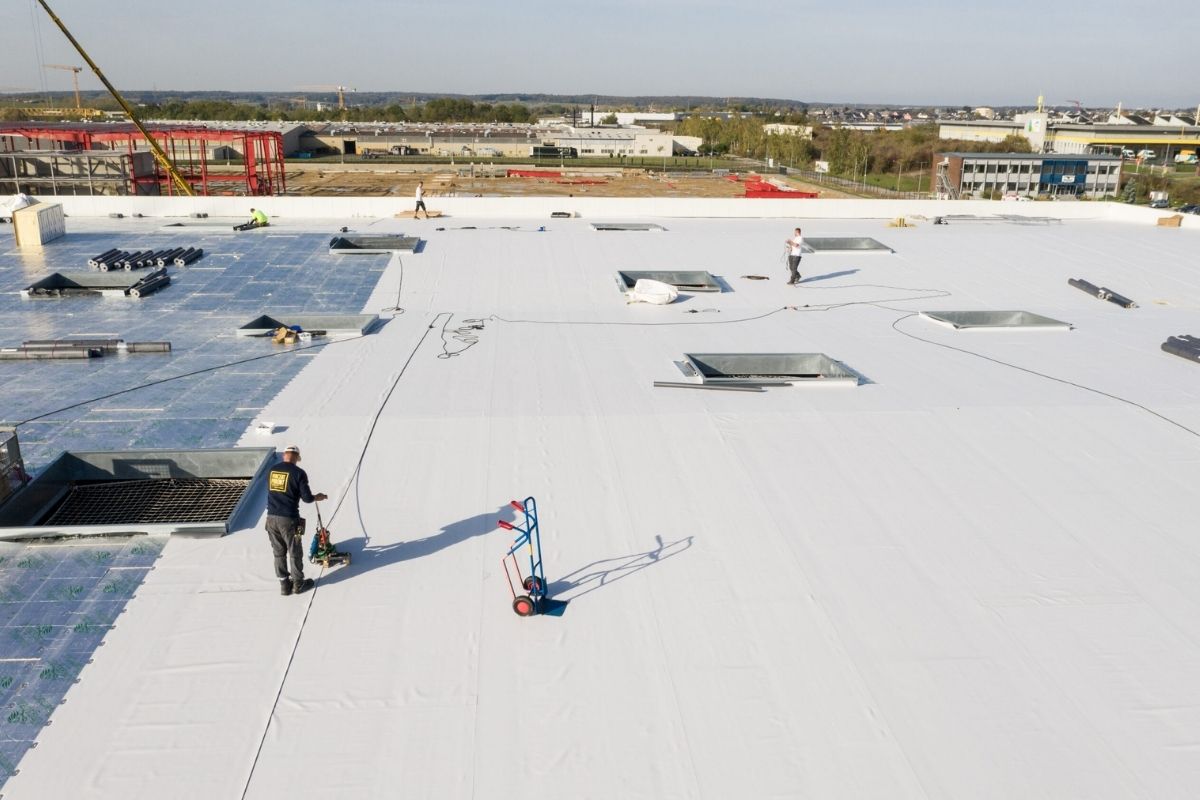
PVC-based synthetic roofing membranes provide a controlled and testable solution for large-span, low-slope, and high-square-meter industrial roofs.
Most Common Problems on Industrial Roofs
Large roof areas often lead to reduced control over system performance:
- Leaks at membrane seams
- Wind uplift-related failures
- UV-induced surface deterioration
- Blistering of aging roofing systems
In industrial facilities, a minor defect can develop into extensive damage. Therefore, the roofing system should be measurable, testable, and controllable in the field.
Why Are PVC Membrane Systems Preferred for Industrial Roofs?
How Is the Application Process Managed?
In industrial facilities, roofing projects cannot proceed without proper control. The process begins with a technical assessment.
- Structural system inspection
- Slope and drainage evaluation
- Review of the existing roofing system
- Fastening layout design
- Detailing solutions
- Wind load calculations
- Mechanical fastening
- Membrane installation
- Hot-air welded seams
- Parapet and drainage detailing
- Weld testing
- Joint inspection
- Technical report prior to handover
The application is carried out by our own installation team, ensuring that quality standards are maintained throughout the project.
5-Year Warranty
For industrial roofing systems, a warranty demonstrates that project risks have been properly managed.
- Appropriate membrane thickness has been selected
- All welded seams have been tested
- The fastening design complies with project requirements
- Critical detail areas have been reinforced
Through this disciplined approach, the roofing system is delivered with a 5-year warranty.
Request a Technical Assessment
There is no one-size-fits-all solution for industrial facilities. The correct roofing system cannot be determined without evaluating the roof type, total area, structural system, and existing conditions. Request a technical assessment to protect your facility for the long term without compromising operational continuity.
Consider your roofing system not as an expense, but as an investment in facility security and operational reliability.
 Contact us directly by phone0212 284 4045
 Get a quick preliminary assessment via WhatsApp
 Request consultation and a technical site survey
“`