“`html
Sandwich panel roofs offer fast installation and lightweight advantages. However, panel joints and fastener details can become the weakest points of the system over time. A leak that appears minor at first can lead to moisture accumulation within the insulation core, reduced thermal performance, and weakening of panel connections.
For this reason, applying PVC membrane over a sandwich panel roof is not merely an additional top layer; it means protecting the existing panel system and extending its service life.
Most Common Problems on Sandwich Panel Roofs
Sandwich panel roofs can develop risks over time due to external conditions.
Leaks that start locally and spread over time.
- Gasket deformation
- Water penetration around fasteners
- Loosening caused by wind uplift
Water ingress during rainfall and damage that remains unnoticed during dry periods.
- Openings at locking points
- Micro-gaps caused by movement
- Installation tolerance errors
The roof may appear intact while its performance declines.
- Moisture accumulation on the underside
- Reduced thermal performance
- Risk of deterioration within the panel core
What Does PVC Membrane Provide on This System?
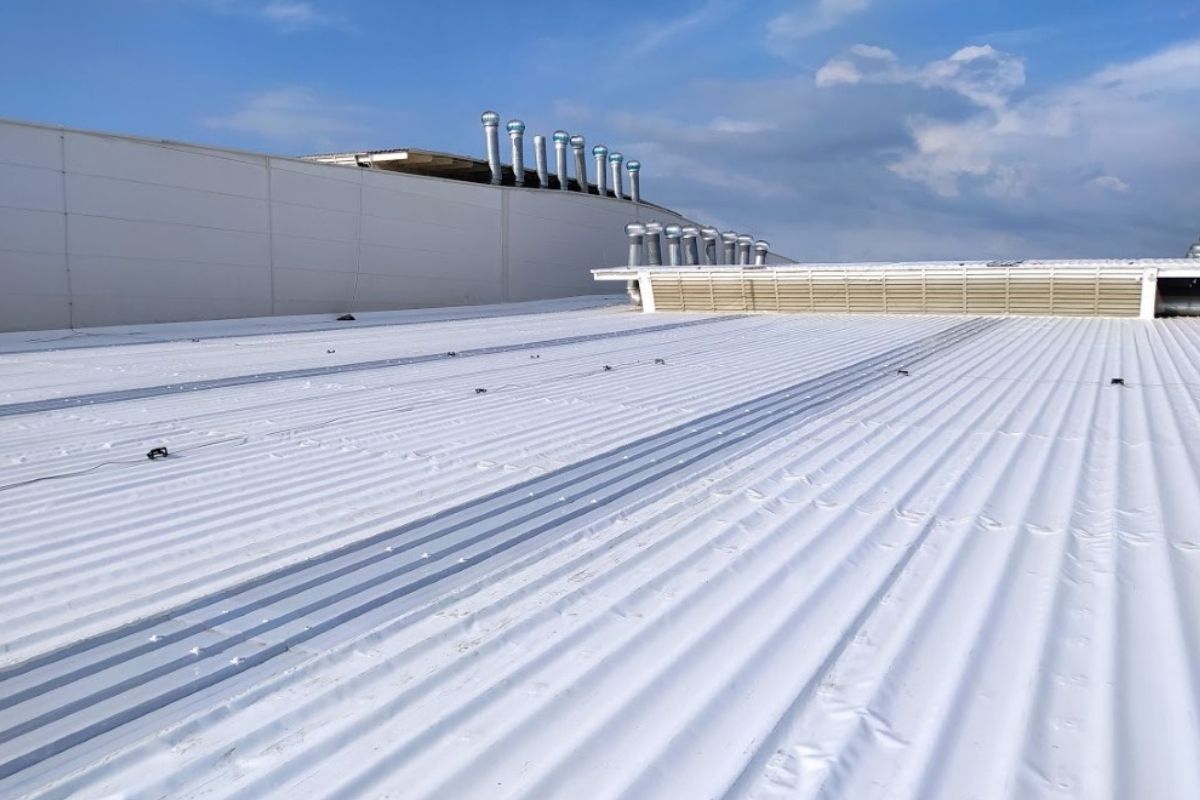
PVC membrane applied over sandwich panels secures panel joints and fastener points with a continuous top-layer system.
| Protection at Joint Lines | Wind Resistance | Long-Term Top Layer |
| Covers panel joints | Stable system with mechanical fastening | Resistance to UV and external exposure |
| Covers fastener points | Accommodates structural movement | Reduces maintenance requirements |
| Eliminates leakage risk | Balances surface tension | Improves operational safety |
This system provides a long-term solution by reinforcing the sandwich panel roof from above without removing the existing roof system.
How Does the Application Process Proceed?
PVC membrane application over sandwich panels is not simply a matter of laying the membrane directly onto the roof.
- Inspection of fasteners and gaskets
- Examination of panel locking lines
- Detection of moisture and deformation
- Reinforcement of loose connections
- Required corrections and repairs
- Mechanical fastening planning
- Controlled welding of seams
- Gutter, edge, and parapet detailing
- Inspection of welded seams
- Testing of critical areas
Once the application is completed, the panel system is not left exposed; it is supported from above with an integrated protective layer.
5-Year Warranty
Sandwich panel roofs are not standard surfaces. A team that does not understand panel behavior cannot ensure system integrity, even if the correct material is used.
For this reason, applications are carried out by our own teams. The detail plan, fastening spacing, and joint solutions are controlled on site.
The warranty we provide demonstrates our commitment to the disciplined application required to protect the panel system.
Suitable Applications
- Panel roofing systems on factory roofs
- Warehouse and storage buildings
- Manufacturing facilities
- Logistics centers
- Renovation projects
No two panel systems are the same. The solution is planned according to the existing structural dynamics.
Consider This Before Making a Decision
Your sandwich panel roof may not be causing problems today. However, fastener points and joint lines weaken over time.
A planned top-layer application protects you from unexpected leaks and costs caused by operational downtime.
Technical Assessment and Quotation
Let us inspect the current condition of your panel roof on site. We will technically assess the connection points and risk areas, then present the most suitable PVC membrane solution in a clear and applicable way.
Consider PVC membrane application over sandwich panel roofs not as an expense, but as long-term investment protection for your building.
Contact us for a technical inspection and quotation.
 Contact us directly by phone0212 284 4045
 Get a quick preliminary assessment via WhatsApp
 Request consultation and a technical site survey
“`