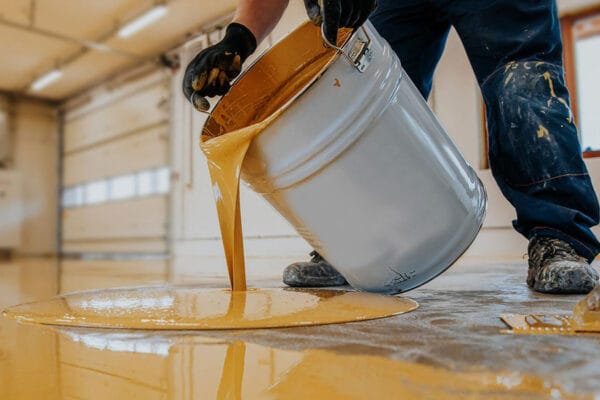
Self leveling epoxy flooring is a type of coating used to obtain smooth, even and aesthetically flawless floors. Since this flooring has a self-leveling feature, it fills the irregularities on the floor and provides an ideal surface. Self-leveling epoxy, which is especially preferred in industrial areas and commercial spaces, attracts attention with its high durability, easy cleaning and visually appealing structure.
What is Self Leveling Epoxy?
Self-leveling epoxy is a flooring system that spreads itself when poured onto the floor, creating a flat and smooth surface. Unlike other types of epoxy floorings, the coating spreads itself smoothly without the need for spreading with tools such as a brush or trowel during application, which provides a perfectly flat surface. Formulated with high-performance epoxy resin and fillers, this flooring fills the slight roughness and cracks on the floor, creating a flawless surface.
Self-leveling epoxy floorings are usually applied in a thickness of 1 to 3 mm and are resistant to abrasion, chemicals, and impacts. At the same time, it is widely used in commercial areas because it provides an aesthetic appearance.
Advantages of Self Leveling Epoxy Flooring
1. Smooth and Flat Surface
One of the biggest advantages of this flooring system is that it creates a completely flat and smooth surface thanks to its self-leveling feature. Small roughnesses, cracks and irregularities on the floors are closed during the coating and a flawless floor is obtained.
2. High Durability
Self-leveling epoxy floorings are extremely resistant to abrasion, impact, chemicals and heavy traffic. These features make it ideal for use in industrial areas with heavy loads and commercial areas with constant human traffic.
3. Easy Cleaning and Hygiene
Thanks to its smooth and non-porous surface, this flooring system does not allow dirt and dust to accumulate. It is extremely easy to clean and provides a hygienic floor. For this reason, it is preferred in areas where hygiene is important, such as food processing facilities, laboratories and hospitals.
4. Chemical Resistance
Thanks to the epoxy resin, self-leveling floorings are highly resistant to chemicals. Acids, bases, oils and various chemical substances can be used without damaging the floor. This feature is an important advantage for areas where chemicals are used intensively, such as industrial facilities and laboratories.
5. Aesthetic Appearance
Self-leveling epoxy floorings also offer a great advantage in terms of aesthetics. With different color and gloss options, they ensure that the floors are both durable and visually appealing. In addition, with a decorative top coat application, the floors gain a modern and professional appearance.
6. Non-slip Surface Options
In areas where it is needed, non-slip additives can be added to the self-leveling epoxy to obtain non-slip surfaces. This increases safety, especially in areas with wet or slippery floors.
How to Apply Self Leveling Epoxy?
1. Surface Preparation
Before starting the flooring application, the ground must be prepared. Dirt, oil, dust and old coating residues on the ground are cleaned. Cracks and gaps on the ground are filled with epoxy mortar and corrected. Having a smooth and clean surface ensures that the coating adheres well to the ground.
2. Primer Coat Application
After surface preparation, a primer coat is applied to the ground. The primer is used to ensure that the epoxy flooring adheres better to the ground and fills the pores on the ground to create a smooth base. After the primer coat is completely dry, the self-leveling epoxy layer is ready to be applied.
3. Self-Leveling Epoxy Application
The epoxy resin mixture is poured onto the ground and begins to spread on its own. Thanks to the feature of this type of flooring, the epoxy covers the ground smoothly without using any tools. A special roller is passed over the ground to remove air bubbles during application. This ensures that the ground is completely smooth.
4. Top Coat Application
If necessary, a protective top coat can be applied over the self-leveling epoxy. This top coat gives the floor extra shine and durability. In addition, if a non-slip surface is desired, non-slip additives can be added at this stage.
Areas of Use of Self Leveling Epoxy Flooring
1. Industrial Facilities
Durable floors are critical in industrial facilities where heavy machinery, chemicals and heavy traffic are present. Self-leveling epoxy offers both abrasion resistance and chemical resistance in these facilities.
2. Commercial Areas
Self-leveling epoxy floorings are preferred for aesthetic and durable floors in commercial spaces such as stores, showrooms, hotels and restaurants. It provides a decorative appearance with different color and pattern options.
3. Warehouses and Logistics Areas
Self-leveling epoxy floorings provide durability and a smooth surface in warehouses and logistics areas where forklifts and other heavy equipment are constantly moving.
4. Food Processing Facilities
It is preferred in food processing facilities where hygiene is of critical importance due to its cleanable and chemical-resistant structure.
5. Hospitals and Laboratories
Self-leveling epoxy floorings are an ideal solution for hospitals and laboratories that require hygienic, easy-to-clean and chemical-resistant floors.
Self-leveling epoxy flooring offers a smooth, aesthetic and durable solution for industrial and commercial floors. Thanks to its self-leveling feature, it eliminates irregularities on the floor and creates a perfect surface. Its structure, resistant to abrasion, chemicals and impacts, is ideal for businesses looking for both aesthetic and functional floor solutions. Offering a wide range of use from commercial stores to production facilities, this flooring is a prominent option among modern floor applications.