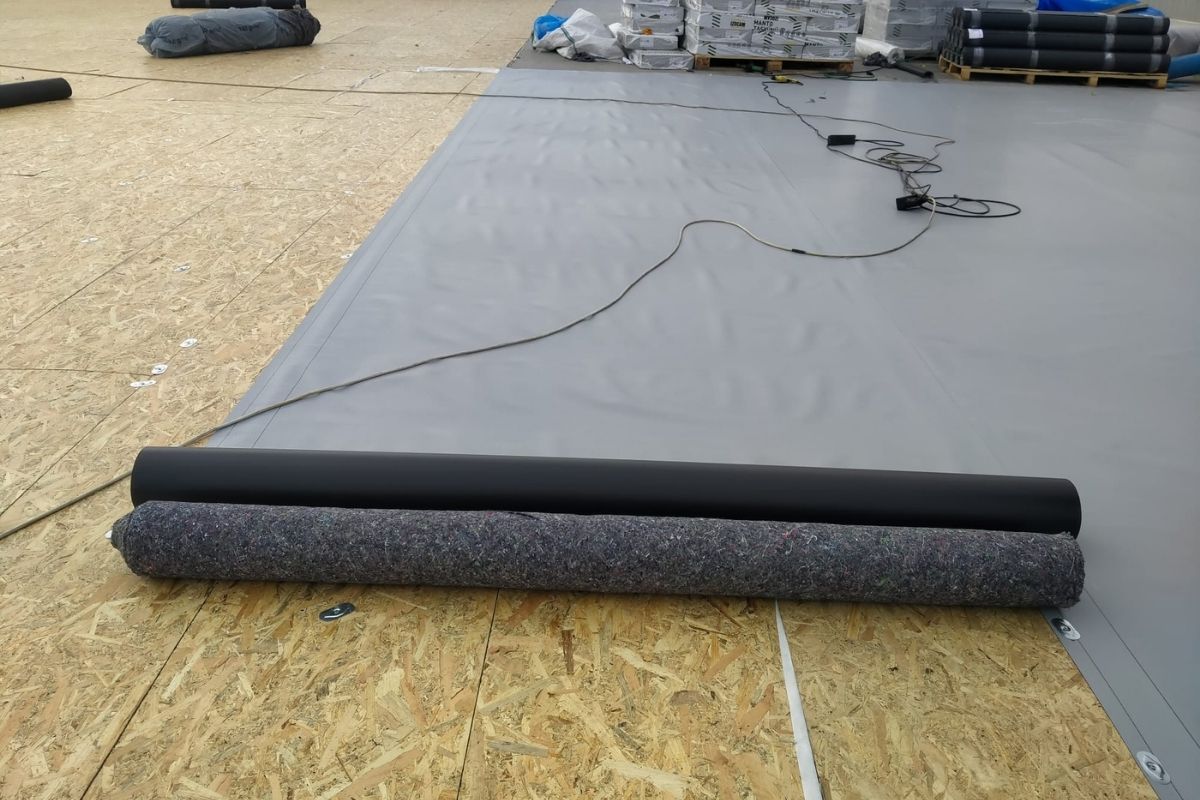
OSB or plywood-covered roofs provide advantages in terms of lightweight construction and fast installation. However, when these surfaces are not properly protected, they become one of the most vulnerable roofing systems against water.
Moisture exposure in wood-based boards can lead to swelling, loss of form, weakened connections, and eventually risks affecting the structural system.
For this reason, PVC membrane application over OSB & plywood is not only about waterproofing; it also means preserving structural stability.
Most Critical Risks on OSB and Plywood Roofs
Wood-based surfaces behave differently from reinforced concrete or metal substrates. If this difference is not properly managed, the system weakens.
- Water penetrating beneath the surface
- Insufficient vapor control
- Openings at board joints
- Expansion caused by temperature changes
- Loosening at screw connections
- Micro-movements on the surface
- Missing vapor barrier layer
- Incorrect fastening method
- Weak detailing at edges and parapets
Why Is PVC Membrane Preferred on These Surfaces?
PVC membrane systems work compatibly with wood-based surfaces thanks to their flexible structure and controlled fastening methods.
3 Critical Advantages
| Flexible Structure | Secure Fastening | Controlled Seam Welding |
| Adapts to movement in the substrate | Creates a stable system through mechanical fastening | Homogeneous seams created through hot-air welding |
| Reduces the risk of tearing | Provides resistance against wind uplift | Minimizes leakage risk |
| Delivers long-term performance | Balances stress across the surface | Provides secure solutions at critical details |
This system prevents OSB or plywood surfaces from being exposed to water and protects the underlying structure.
Critical Stages in the Application Process
Applications on wood-based substrates require strict discipline. A small mistake can turn into serious damage.
- Inspection of board connections
- Moisture condition analysis
- Strengthening of screw and joint areas
- Application of a vapor barrier where required
- Balancing moisture transmission from the substrate
- Mechanical fastening planning
- Controlled welding of seams
- Secure detailing at edges, drainage points, and critical areas
- Inspection of welded seams
- Testing of critical connection points
Once the application is completed, the surface is not merely covered; it is systematically protected.
Why Do We Use Our Own Teams?
Applications over OSB and plywood are more sensitive than standard roofing applications. A team that does not understand the substrate may weaken the system even if the correct membrane is selected. For this reason, we carry out the process with our own teams and directly control the fastening plan and detailing solutions.
The warranty we provide demonstrates our commitment to an application process designed with the surface behavior in mind.
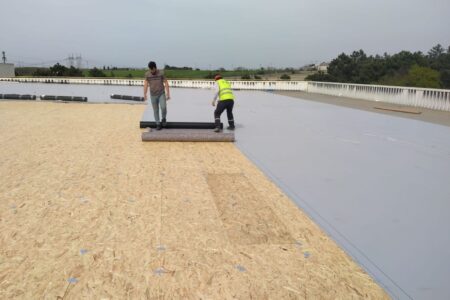 Suitable Applications
- Steel structure roofs
- Lightweight building systems
- Warehouse and production areas
- Renovation projects
- Wood-based surfaces beneath sandwich panel systems
Every surface type is different. The solution is planned according to the existing layer structure.
Consider This Before Making a Decision
When OSB or plywood surfaces start taking in water, the damage does not remain on the surface. It progresses into lower layers and connection points. A properly planned PVC membrane system prevents this process from the beginning.
Technical Assessment and Proposal
Let us evaluate your existing surface on site. We will identify moisture risks, connection conditions, and the most suitable system solution from a technical perspective.
Consider PVC membrane application over OSB & plywood not as an expense, but as long-term investment protection for your structure.
 Contact us directly by phone0212 284 4045
 Get a quick preliminary assessment via WhatsApp
 Request consultation and a technical site survey